What is the RDLS?
The Risk Data Library Standard (RDLS) is an open metadata standard for describing risk datasets used in climate and disaster risk assessments.
Metadata is data that provides information about a dataset. The RDLS covers metadata that can apply to any dataset, such as a dataset’s title and author, and metadata that is specific to risk datasets, such as the type of hazard a dataset relates to.
What is a risk dataset:
RDLS defines metadata tailored to describe the details of risk datasets, specifically:
Hazard datasets describe estimated or observed hazard intensity in disaster events (e.g. contained in geospatial layers or tables).
Exposure datasets describe the location and attributes of population, buildings, infrastructure, natural resources and other tangible assets.
Vulnerability datasets describe the relationship between hazard intensity and potential impacts on exposed assets by means of vulnerability and fragility curves, damage-to-loss models or generic socio-economic vulnerability indexes.
Loss datasets contain the estimated losses, risk or impact of disasters and climate shocks, as a result of analysing hazard, exposure and vulnerability.
See also
For specific examples of different types of risk dataset, refer to the schema reference documentation:
What isn’t a risk dataset:
RDLS is not intended to describe the ‘raw’, ‘baseline’ or ‘contextual’ datasets used in creating hazard maps, exposure datasets and vulnerability curves. Many of these datasets’ can be very well described using existing geospatial metadata standards, such as ISO 19115 or Dublin Core, and do not require the risk-specific details that are the focus of RDLS. Datasets used in the creation of a risk dataset can be linked to from the lineage/sources array of a risk dataset’s metadata.
The following table provides examples of risk datasets and ‘raw’, ‘baseline’ or ‘contextual’ dataset for each type of risk data:
Risk data type |
Risk datasets |
Raw, baseline or contextual datasets |
|---|---|---|
Hazard |
|
|
Exposure |
|
|
Vulnerability |
|
|
Loss |
|
|
Metadata and content
RDLS provides a schema for metadata about risk datasets. That is, data that describes risk datasets so that they can be found, understood, managed and used effectively.
RDLS does not impose a structure or format on the content of risk datasets. Datasets may include additional attributes to those described by RDLS metadata.
The following table provides examples of content and metadata for each type of risk data:
Risk data type |
Content |
Metadata |
|---|---|---|
Hazard |
As a minimum, the hazard intensity at each of many locations for the event or scenario represented. |
Event name and description, analysis approach, hazard(s) represented, intensity metrics used, climate scenarios represented. |
Exposure |
Location, category, value, and taxonomy code of assets. |
Exposure categories, asset properties, associated quantities and cost units, taxonomy reference. |
Vulnerability |
Vulnerability relationship between hazard intensity and exposure categories based on functions or spatial proxies. |
Relevant hazard and exposure classification, details on the function type and approach, impact classification, spatial proxy indicator description. |
Loss |
Impact and loss values, and location/area they apply to. |
Type of hazard and exposure considered, type and unit of impact considered, datasets used in generating the losses. |
The RDLS schema
The RDLS schema defines the meaning, structure and format of RDLS metadata. It defines the list of fields that can be used to describe risk datasets. RDLS metadata is structured as follows:
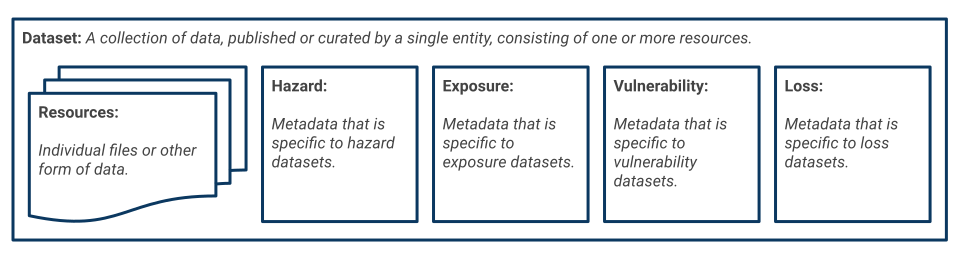
Metadata fields that are common to all resources are specified at the dataset level, whilst metadata fields that can vary by resource are specified at the resource level. Metadata fields that are specific to a particular type of risk data are specified at the dataset level and grouped under the relevant object: Hazard, Exposure, Vulnerability or Loss.
The schema specifies a title, description and data type for each field. The schema also specifies other rules to which RDLS metadata needs to conform, such as which fields are mandatory and whether fields need to conform to a particular format or range of values. Some fields refer to codelists to limit and standardise their values.
For example, the risk_data_type field is defined as follows:
Title |
Description |
Type |
Format |
Required |
|---|---|---|---|---|
risk_data_type |
array[string] |
Required |
||
Risk data type |
The types of risk data included in the dataset, from the closed risk_data_type codelist. |
|||
For more information on the fields, structure and format of RDLS metadata, refer to the metadata reference.